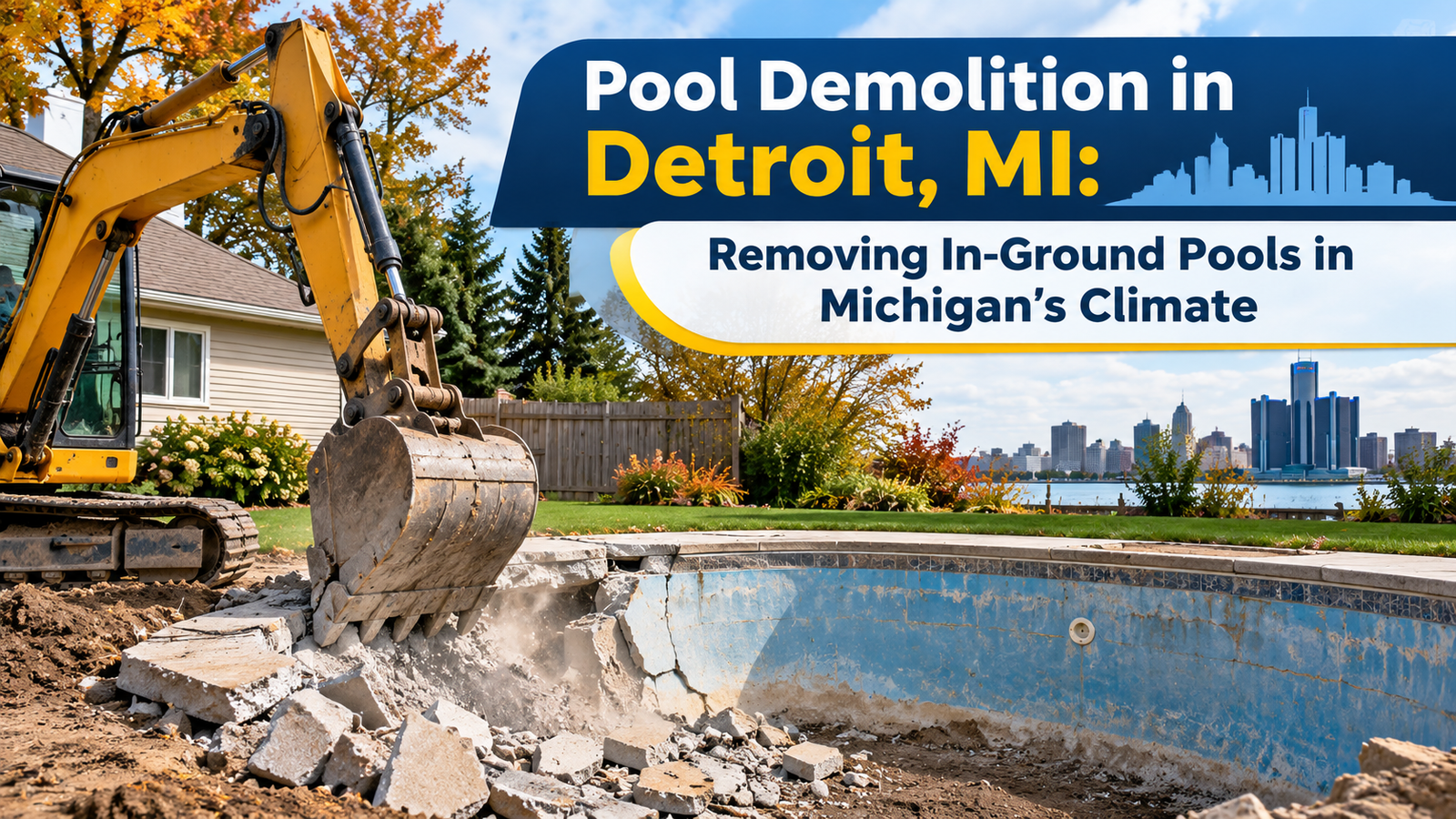
In-ground swimming pools that have reached the end of their useful life through structural deterioration, the expense of ongoing maintenance and repair, or simply a change in the homeowner’s circumstances or priorities are increasingly being removed rather than restored. pool demolition Detroit is a specialized scope of work that removes the pool shell, backfills the excavation, and restores the yard to usable condition. In Detroit and the surrounding metro area, Michigan’s climate adds specific dimensions to the pool removal process: the freeze-thaw cycles that damage pool shells, the region’s clay-rich soils that complicate backfilling, and the specific permitting environment of Detroit and its surrounding municipalities all shape how pool demolition projects are planned and executed.
Why Homeowners Remove Pools in the Detroit Area
The decision to remove an in-ground pool rather than repair or maintain it arises from several circumstances. The most common is simply the economics of an aging pool: concrete pools crack, shell coatings fail, plumbing and mechanical systems age, and the cumulative cost of repairs and annual opening/closing cycles reaches the point where removal is more practical than continued investment. Detroit’s climate is particularly hard on in-ground pools the freeze-thaw cycling through Michigan winters stresses pool shells, the freeze-thaw pressure on hydraulic fittings causes leaks, and pools that are not properly winterized can experience catastrophic cracking from ice formation.
Liability and safety are also motivating factors. An abandoned or deteriorated in-ground pool on a vacant or semi-occupied property represents a safety hazard the pool shell and any water or ice it contains can injure a child or adult who enters the property. Detroit’s BSEED enforcement may require removal of deteriorated pools on properties subject to code compliance action. Property owners seeking to sell a property may find that an aging pool reduces its marketability or creates concern for buyers about the ongoing maintenance obligation.
Estate situations and property consolidation also generate pool removal demand. When a property is inherited by family members who do not intend to use or maintain the pool, removal is often the practical choice. When a property is being prepared for sale or rental and the pool is not an asset for the target market, removal allows the yard to be used for other purposes.
Pool Removal Methods: Full Demolition vs. Partial Fill
Pool removal can be accomplished in two ways: full removal (complete demolition and excavation of the pool shell and all surrounding concrete, with backfill of the full excavation) or partial fill (punching holes in the bottom of the pool shell to allow drainage, crushing the walls inward or breaking down the shell partially, and filling the remaining void with compacted material). Full removal leaves the site with no remnant of the pool structure and allows the land to be used for any purpose building additions, landscaping, or anything that requires a known, uniform subgrade.
Partial fill is a less expensive approach that is appropriate for some situations: when the land will remain as open yard, when no future construction requiring a known subgrade is anticipated, and when the site conditions allow the remaining crushed shell material to be treated as an engineered fill. The key requirement for partial fill in Michigan is that the drainage holes punched in the pool bottom adequately drain the structure before and after backfill, preventing the creation of a underground water retention structure. Many Detroit-area municipalities require that partial fill pools be disclosed on the property record so future owners know the fill condition is present.
Full removal is the right choice when the property may be developed further, when the homeowner wants a clean slate for yard use, or when the soil conditions make partial fill engineering complex. The excavated concrete from full removal is typically crushed and recycled as aggregate.
Michigan’s Permit Requirements for Pool Demolition
Pool demolition in Michigan’s municipalities requires a demolition permit from the applicable local building department. In Detroit, BSEED issues demolition permits for pool removal in the same way it does for building demolition. Permit requirements typically include a site plan showing the pool location, documentation of utility disconnections (pool electrical, gas for heaters, water fill lines), and a description of the removal method and backfill plan.
Michigan Act 174 (MISS DIG) requires utility notification before excavation for pool demolition, the same as for any other excavation. Pool utilities the electrical service to the pump, filter, and heater; the water fill line; and the gas line to gas heaters must be disconnected and abandoned at their source before removal. DTE Energy and Consumers Energy (or the applicable municipal utility) must disconnect these services. Pool plumbing lines in the ground should be removed or filled with grout to prevent the creation of underground pathways that can direct groundwater movement in the fill.
Backfill and Site Restoration in Detroit’s Clay Soils
Backfill quality is the most critical factor in pool removal site restoration, particularly in Detroit’s clay-rich glacial soils. Clay-rich soil used as backfill compacts poorly compared to granular fill and is susceptible to future settlement as it consolidates under its own weight and from surface loads. Settlement of pool backfill areas after removal creates depressions in the yard, can damage surface drainage patterns, and in severe cases can undermine adjacent structures or hardscaping.
Good pool removal practice uses engineered fill clean granular material that compacts densely and provides predictable bearing capacity rather than the excavated soil alone. The granular fill is placed in lifts and compacted with mechanical equipment to achieve specified density. If the homeowner wants to use the area for a structure addition, patio, or other loaded surface in the future, the fill must be placed to the density standards required for those uses. For simple lawn restoration, less demanding compaction is acceptable, but adequate compaction to prevent significant settlement is still important for a uniform yard surface.
Frequently Asked Questions: Pool Demolition in Detroit, MI
What permits are required for pool removal in Detroit?
Pool demolition in Detroit requires a demolition permit from BSEED (Building, Safety Engineering and Environmental Department). The permit application typically requires a site plan, documentation of pool utility disconnections (electrical, gas, water), and description of the removal method. Michigan Act 174 also requires MISS DIG (811) notification before excavation for the pool removal. Electrical and gas utility disconnection by DTE Energy and Consumers Energy (or applicable municipal utilities) must be completed before mechanical demolition begins.
What is the difference between full pool removal and partial fill?
Full removal involves demolishing and excavating the entire pool shell and surrounding concrete, then backfilling the full excavation with engineered compacted fill. This leaves no pool remnant and provides a clean, uniform subgrade for any future yard use. Partial fill involves punching drainage holes in the pool bottom, breaking down the walls partially, and filling the remaining void with compacted material a less expensive approach appropriate when no future construction requiring a known subgrade is planned. Full removal is preferred for property flexibility and for sites where the future use is uncertain.
Why does Michigan’s climate make pool maintenance difficult and sometimes drive removal decisions?
Michigan’s winters subject in-ground pools to severe freeze-thaw cycling. Pool shells concrete, vinyl liner, or fiberglass are all vulnerable to damage from freezing water pressure in the structure. Concrete pools crack, vinyl liners tear from ice, and fiberglass shells can delaminate when freeze-thaw forces act on inadequately winterized pools. The annual winterization and spring opening process, the ongoing maintenance of aging mechanical systems, and the repair bills from freeze-related damage accumulate over decades and often tip the economics toward removal.
How should pool backfill be handled to prevent future settlement in Detroit?
Preventing settlement in pool backfill requires using clean granular fill material crushed concrete, clean gravel, or engineered fill rather than the excavated clay-rich native soil alone, and compacting the fill in lifts of approximately 8 to 12 inches using mechanical compaction equipment. The number of compaction passes and the target density depend on the future use of the filled area. For simple lawn restoration, adequate compaction to prevent visible settlement is the goal. For areas that will be loaded with a patio, structure addition, or paved surface, the fill should be compacted to 95 percent of maximum density to meet structural load requirements.